Employment contract Australia small business: clauses and gaps
You’ll learn the must-have clauses for a compliant contract and how to avoid unenforceable wording. You’ll also know when a simple amendment is enough and when a full rewrite is required.
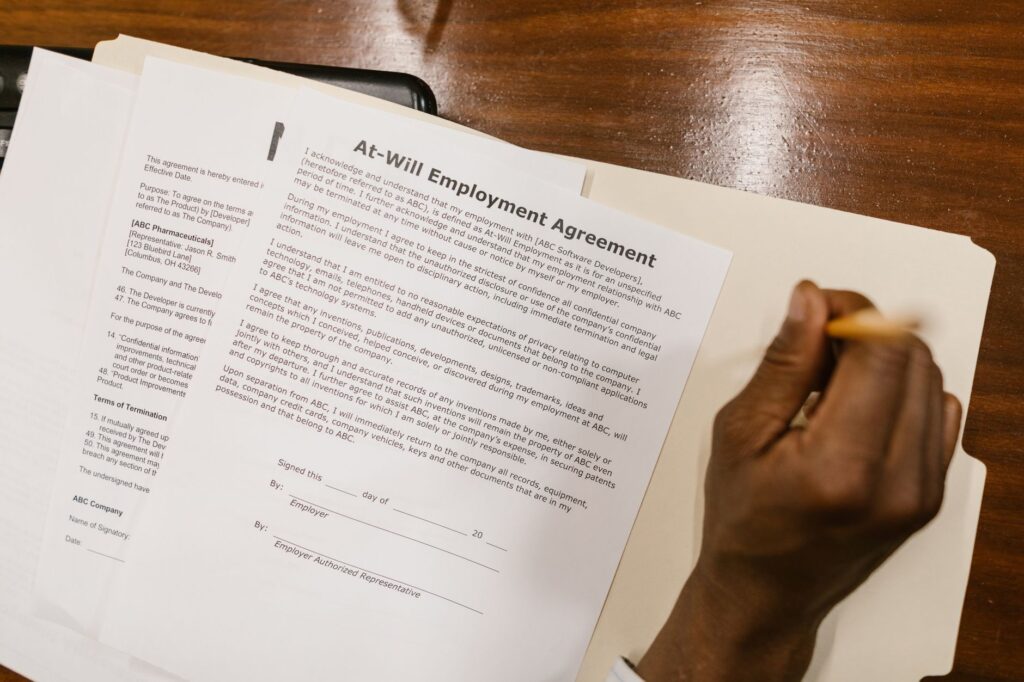
You’ve just hired your first employee and the contract on your desk looks more like legal jargon than a clear agreement. This guide will settle what clauses must be in an employment contract Australia small business, which ones can backfire, and how the contract fits with awards and the NES.
Start with the core details: name, role, start date and pay
Australian law requires the contract to state the employee’s full name, the position they are hired for, the agreed start date and the agreed rate of pay. Use the current national minimum wage of $26.44 per hour or $1,004.90 per week as the floor – any lower rate is unlawful. Include the superannuation guarantee of 12 per cent and note that super must reach the employee’s fund within seven business days of each payday. Record the ordinary hours of work, any shift-work arrangements and the right to disconnect that applies to small business employers since 26 August 2025. Practical step: draft a table that captures name, role, start date, hourly or weekly rate, super and hours, then have the employee sign it before the first shift.
Align the contract with the relevant award and the NES
Most small businesses are covered by a modern award that sets out additional pay rates, loadings and leave entitlements. The contract cannot offer less than the award or the National Employment Standards (NES). If the award provides a higher casual loading or overtime rate, those terms must be copied into the agreement. Conversely, you cannot contract out of the NES – for example, you cannot waive the 10 day paid sick leave entitlement. The practical order is: identify the applicable award, list the award-based entitlements that affect the role, and then mirror those in the contract. If you are unsure, a quick check on fairwork.gov.au will confirm the correct award and its minimums.
Include the essential enforceable clauses
These clauses survive a dispute and give both parties clear expectations. They include duties and responsibilities, ordinary hours and flexible-work options, annual leave accrual, sick leave, parental leave, confidentiality, intellectual-property ownership, notice periods for termination, and a simple dispute-resolution process. Each clause should be written in plain language and reference the award where relevant. Practical step: copy the list below into your template, then tailor each point to the specific role.
- Job duties and performance expectations
- Hours of work, breaks and overtime rates
- Leave entitlements as per the NES and award
- Confidentiality and data-security obligations
- Intellectual-property ownership for work created
- Notice period – minimum one week, or as the award stipulates
- Simple dispute-resolution – internal discussion followed by Fair Work mediation
Avoid over-reaching clauses that can be struck down
Clauses that try to limit lawful rights, such as excessive non-compete periods, blanket restraints on trade or notice periods that exceed award limits, are likely unenforceable. The Fair Work Commission routinely strikes down terms that give the employer an unfair advantage. Keep non-compete clauses short (12 months max) and limited to genuine business interests, and never require the employee to waive statutory leave. Practical step: review each restrictive clause against the award and the NES; if it goes beyond, delete or shorten it.
Rewrite the contract when patching isn’t enough
If you find yourself adding dozens of amendments, the contract has become a patchwork and is harder to enforce. Signs you need a full rewrite include frequent disputes, multiple award references, or a change in business structure. Start a fresh draft that incorporates all mandatory and essential clauses in a single document. This is where a fractional HR partner can save you time – see how ACTIv8 works and compare the plans and pricing to decide if a dedicated HR specialist is worth the investment for your small business.
Questions we hear about this
Do I need a lawyer to draft the contract? Not necessarily. A plain-English template that follows the guidelines above is usually sufficient, but have a qualified HR professional review it to avoid hidden pitfalls.
Can I use the same contract for all employees? You can use a master template, but you must adjust role-specific duties, pay rates and any award variations for each position.
What happens if I forget the super guarantee deadline? Late super payments attract penalties and may be treated as a criminal offence for intentional underpayment since 1 January 2025, so set up automatic payroll to meet the seven-day rule.
Rather have someone own this for you? Reach out to ACTIv8. Senior HR support for less than half the cost of hiring in-house.